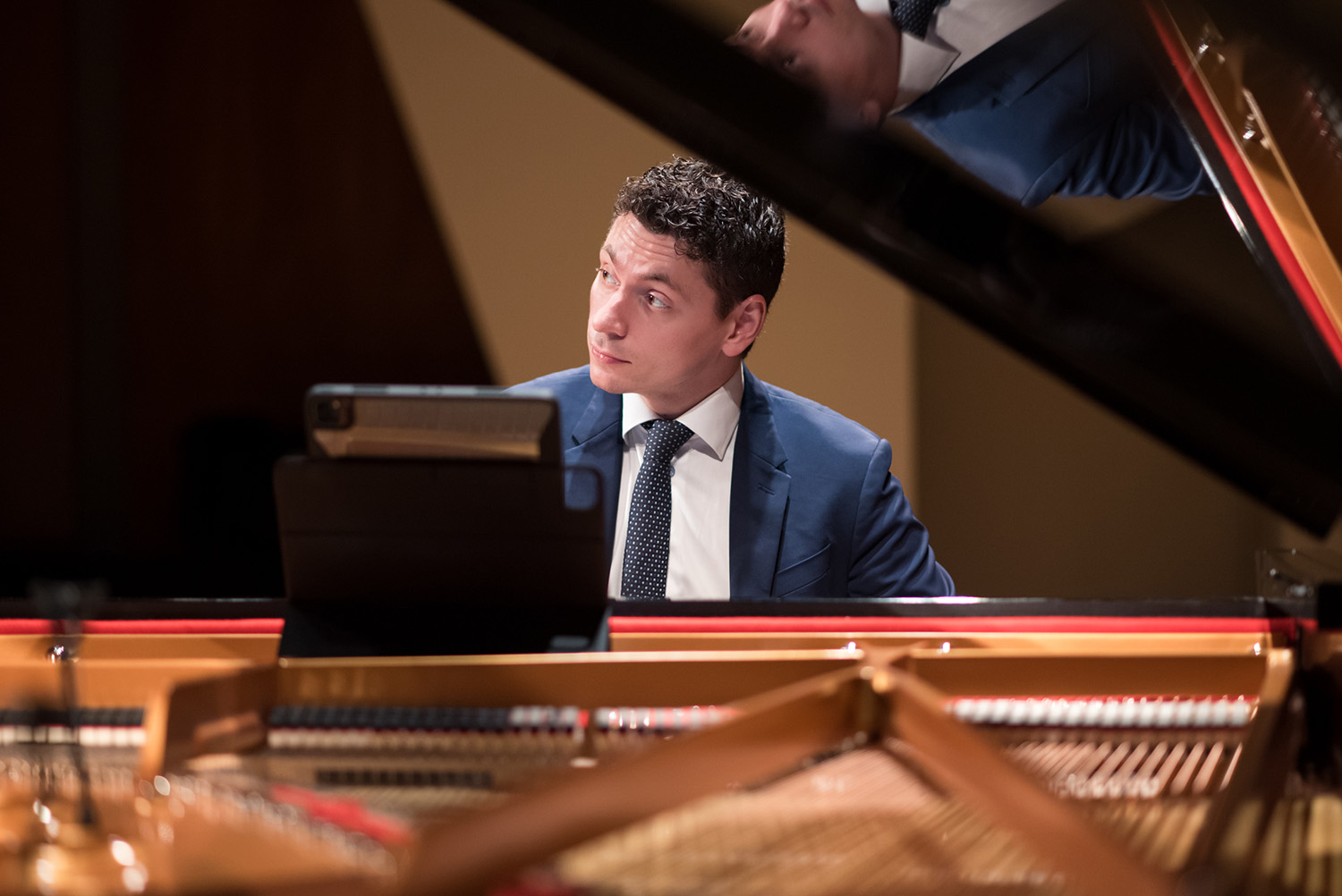
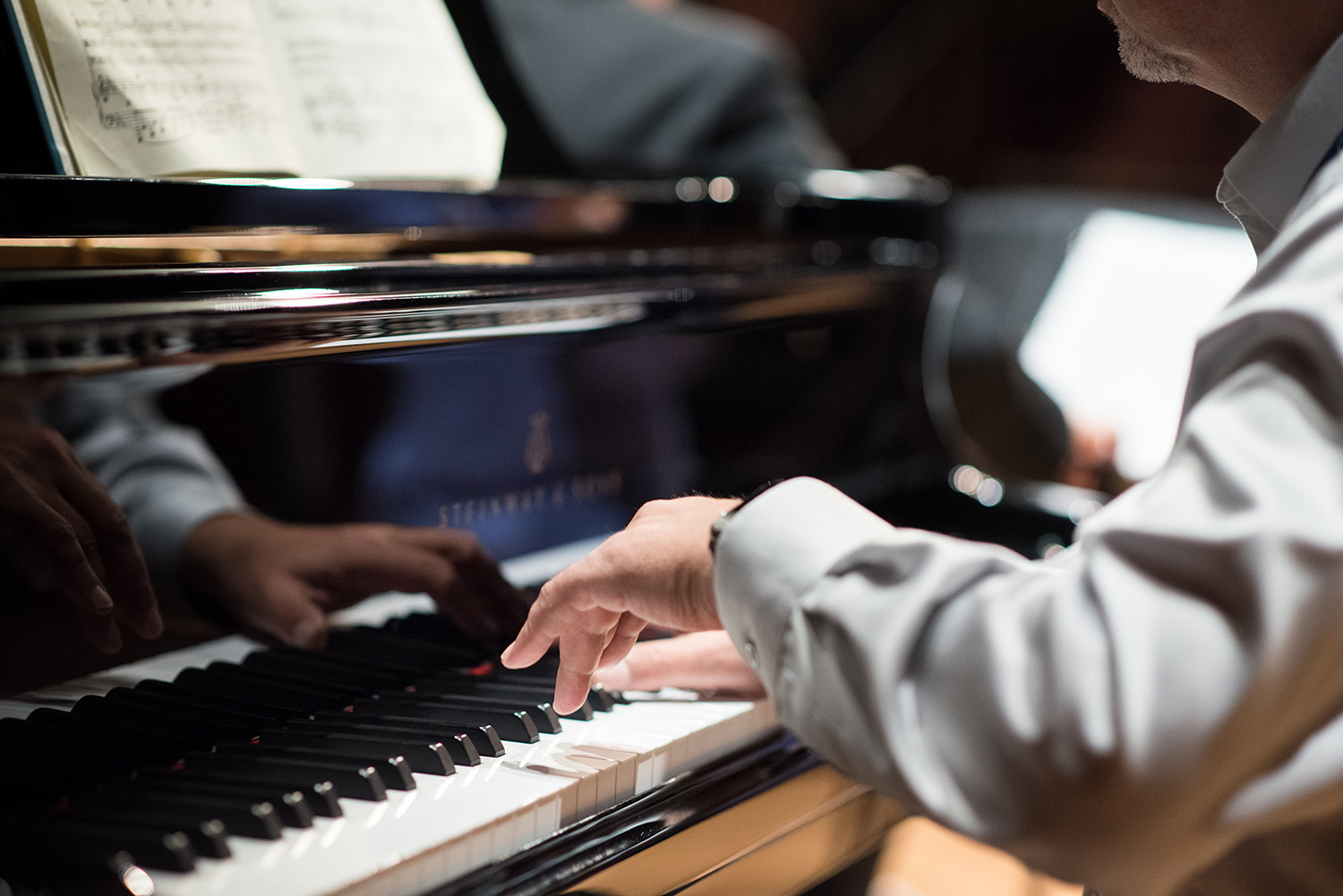
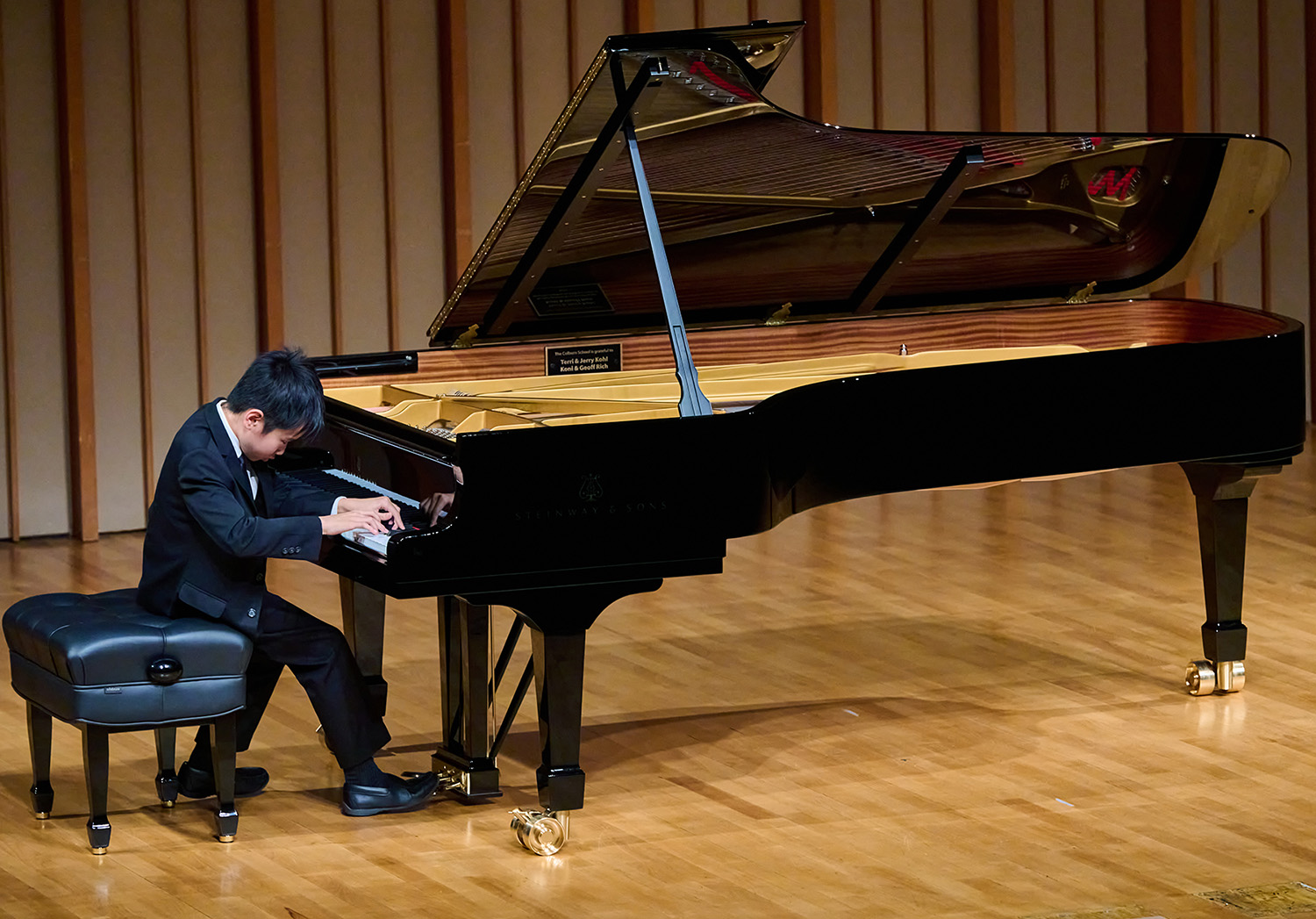
From Kawai to Steingraeber and so many more world-renowned manufacturers, the Colburn School has built a diverse fleet of pianos. Recently, Fabio Bidini, Carol Colburn Grigor Piano Chair, and Neema Pazargad, director of Piano Technology, shared why such a representative piano fleet is an appealing factor for guest artists, faculty, and students. Plus, see how the Piano Investment Fund seeks to expand Colburn’s future fleet.
Share
From the black-and-white keys to its distinctive shape and beautiful sheen under the spotlights, a concert grand piano naturally commands a preeminent presence on any stage. But not all grands are identically interchangeable. Each manufacturer has their own approach, materials, and production processes that give their instruments a uniqueness, which is why the Colburn School has assembled a highly diverse piano fleet.
Colburn has curated a collection of 175 keyboard instruments, ranging from harpsichords and fortepianos to upright pianos and five- to seven-foot historic and modern grands. The instruments are used for classroom instruction, including dance studios, as well as for students’ rehearsal needs and performances. Of course, the pinnacle of the fleet are the School’s nine-foot concert grands and the fact that they don’t all hail from a single manufacturer. Rather, the School purposefully has assembled a collection of grands from Steinway & Sons, Kawai, Fazioli, Mason & Hamlin, and most recently Steingraeber, with hopes to add Yamaha and Bosendorfer. While it may not be unusual for performing arts organizations to compile a fleet of pianos, it is virtually unheard of for that fleet to consist of such a plethora of manufacturers.
“I think there’s only one other place in the world you could go to right now where you would even have an opportunity to play so many different concert grands and that’s a big piano show in Nuremburg, Germany, that happens every year,” says Neema Pazargad, director of Colburn’s Piano Technology department.
“We’re very proud that at Colburn, we can give artists, teachers, or performers an option to play on any one of these instruments,” he adds. “It gives us such flexibility to allow an artist to pick a piano based on the repertoire they’re playing.”
Carol Colburn Grigor Piano Chair Fabio Bidini points out how a diverse fleet can empower pianists when it comes to selecting the instrument that will give a repertoire its strongest, most compatible voice.
“If the action of the piano permits you to do what you really want, then it offers an infinite amount of colors, an infinite amount of possibilities,” he said.
Plus, access to pianos crafted by different manufacturers offers students additional notes to their education. Performing on the different instruments builds a familiarity with their unique characteristics, which is a key advantage to their future performing careers.
“Part of Colburn’s philosophy is to expose our students to as many makers as possible because, when they go out into the world to perform, they don’t know what piano they will see. They don’t know if it will be a Yamaha. They don’t know if it will be a Steinway. This is their training grounds to be able to adapt to whatever maker it is, training their ears and understanding that matchmaking between piano and repertoire,” says Nina Zhou Girard, Assistant Vice President, Academic Philanthropy.
Supporting a Future Fleet
The School’s piano fleet is carefully maintained by the highly skilled Piano Technology department. Their expertise keeps the instruments in excellent performance shape—approximately $500,000 is needed annually to provide the highest quality of care. However, over time and hundreds of hours of use, the pianos begin to age out. That’s when Pazargad and Bidini initiate the thoughtful process of purchasing a new piano, such as the Steinway & Sons acquisition last year. Its addition was made possible by the generous contributions of Terri and Jerry Kohl and Koni and Geoff Rich.
In fact, donors to Colburn’s Piano Investment Fund help build and maintain the fleet, including the newest member, a Steingraeber concert grand that Pazargad and Bidini spotted in a Washington D.C. shop. This manufacturer produces fewer than 80 grand pianos each year, making them extremely rare.
“They couldn’t believe their eyes that there was this Steingraeber a few years old and in great condition,” says Girard. “We were able to secure funds through a select few donors who recognized the value a piano of that caliber adds to the fleet.”
Thanks to the generosity of the Tippet Rise Fund of the Sidney E. Frank Foundation, Ann Moore, and Dr. Lawrence Rubenstein and Dr. Susan Anyang, the Colburn School was able to welcome this remarkably rare and extraordinarily distinct Steingraeber concert grand onto campus for students.
In addition to purchasing instruments, our generous community at times donates pianos and other instruments to Colburn. For example, the model A Steinway grand from the former home of the legendary violinist Jascha Heifetz was recently donated to the School for both its historic and educational value to the students. It is thanks to the generosity and keen eye of donors like David Adams, grandson of Florence Vidor who married Mr. Heifetz in 1928, that a piano with such historic relevance could make its way to Colburn.
Plus, Colburn is currently hosting a Piano Sale, inviting the public to purchase the School’s pianos that are being phased out as well as others donated by the community. The proceeds go to the Piano Investment Fund to help expand the fleet to meet the increased demand generated by Colburn’s campus expansion. In 2024, the Colburn School broke ground on a transformational campus expansion designed by Frank Gehry. Located across the street from the School’s existing campus at the intersection of Olive and Second Streets, the building will include the Terri and Jerry Kohl Hall, a 1,000-seat in-the-round concert hall, five professional-sized dance studios including a 100-seat studio theater, and gardens that bring fresh air and green spaces to the downtown landscape. The goal is to add 20–25 new pianos before the new building’s scheduled opening in 2027.
Born out of a commitment to serve both the community and the School, the expansion will greatly expand the facilities for performance and learning. The students, faculty, and guest artists who use these new spaces will require instruments of the highest caliber to support their artistry and to match the excellence of the facilities.
To date, six pianos have been sold through the Piano Sale and 10 remain available. For more information about purchasing one of the instruments, go to our Piano Sale website.
The Colburn School appreciates our generous supporters who enable us to provide our students, faculty, and guest artists with stellar performance facilities and instruments. If you’d like to aid in advancing the Piano Investment Fund or make a gift to the School, please visit contact Nina Zhou Girard at nzhou@colburnschool.edu.